You Voted for It...



RIGHTEOUSNESS…
We live in a world built on two quiet engines of self-justification: in-group bias and moral licensing. In-group bias means we favour “us” and downplay “them” — a bias so basic it shows up even when groups are chosen at random. (Wikipedia) Moral licensing means when someone does something morally good (or aligns with a group that does), they feel entitled, often unconsciously, to slip into behaviour that contradicts that good without feeling immoral. (SpringerLink)
Now imagine a snow-globe: pretty, swirling, contained. Shake it, and you see motion. But inside, the flakes never settle; the scene never changes. That’s our political environment. Every day: crisis, outrage, blame; same patterns repeated. The ground doesn’t shift, but the storm feels new.
Here’s the gut-punch: the people who say “You voted for it!” and the people who mock that remark, they’re playing the same game. Both sides are icing each other morally with one hand, while smashing the glass with the other. They assume moral clarity, yet both feed the snow-globe.
Because what if you didn’t vote for that specific thing? What if you voted for a brand, or a promise, or a feeling and what emerged was something unimagined? It matters, because blame without nuance is not moral reckoning: it’s division. And in that division, we’re the snow-globe’s inhabitants, motion-sick and disoriented, while the system outside watches the chaos.
SMOKE AND MIRRORS…
When partisans mock each other, the words change costumes but not choreography.
“Cry more, lib.” “Enjoy your gas prices.” “You voted for it.”
They’re mirror phrases, reflexive sneers that disguise fear as superiority.
Social psychologists have studied this reflex for decades. A 2019 paper in Nature Human Behaviour found that both conservatives and liberals overestimate the extremism of the opposing side by more than 50 percent. In other words, the caricature each tribe mocks is mostly imaginary. Yet the ridicule feels righteous, because it confirms belonging; that small jolt of dopamine we get when our group laughs together at the “idiots” outside the circle.
The right perfected that ritual through talk-radio swagger and online trolling; the left adopted it through moral sarcasm and “ratio” culture. Different fonts, same format. Both operate as social grooming: humiliate the outsider, reinforce the hive. The algorithm rewards it, the crowd amplifies it, and the individual feels momentarily pure.
The result isn’t persuasion; it’s performance. In 2023, Pew Research reported that only 14 percent of Americans believe political conversations on social media are “respectful,” while nearly 60 percent describe them as “angry” or “frustrating.” It’s not because people forgot how to reason, it’s because outrage is easier to perform than understanding is to practice.
Inside the snow globe, it’s hard to tell who’s shaking it anymore. Each side claims moral gravity while floating in the same static storm, pelting one another with snow that never melts.
OMNISCIENT VOTING…
The most common accusation in American politics isn’t treason or corruption. It’s clairvoyance.
“You knew what you were voting for.”
Except voters rarely do. Campaigns are built to obscure complexity. They sell brand identities, not policy roadmaps. In 2016, Pew Research found that 77% of Trump supporters said they were voting more against Clinton than for Trump, a protest impulse, not an endorsement of specific actions. Similar data from 2020 showed nearly half of Biden voters were motivated primarily by opposition to Trump rather than alignment with Democratic policy. Both elections were referendums on fear.
And fear, not foresight, drives turnout.
When Trump supporters cast ballots, few imagined the list that followed: military deployments into U.S. cities, unmarked agents detaining citizens, federal force used against journalists, ICE separating families and deporting American residents on clerical errors. None of that appeared in campaign literature or stump speeches. They didn’t “vote for it”, they enabled it, unknowingly, through faith in a persona sold as strength.
The same blindness applies across the aisle. Arizona voters didn’t check a box labeled “Minimum Wage — No.” Yet that’s what Kyrsten Sinema delivered. West Virginians didn’t vote for coal subsidies over healthcare, but Joe Manchin made that trade on their behalf. Decades earlier, Connecticut Democrats didn’t authorize Joe Lieberman’s hawkish foreign policy or his crusade against video games, yet they bore his decisions as if they were theirs.
We punish the public for sins they didn’t commit and reward politicians who sold one promise and delivered its opposite. The logic collapses under its own weight: if every vote is prophetic, then no deceit is possible.
But deception is the lifeblood of modern politics.
The average campaign ad lasts 30 seconds. The average major policy bill exceeds 500 pages. The information gap is not ignorance; it’s design.
Holding voters morally responsible for the entire aftermath of their vote is like blaming a passenger for the pilot’s mid-air dive. You can say they boarded the plane, but they didn’t grab the controls.
The Reflex…
When people feel powerless, blame becomes a kind of self-defense. It turns chaos into a story where someone can be punished, and that’s close enough to control.
Neuroscience backs this up: MRI studies from Emory and Dartmouth show that partisan brains light up in the reward centers when they read headlines humiliating the other side. The reaction is almost identical to winning a small bet. Blame, in other words, is pleasure disguised as principle.
Every “you voted for it” or “cry more, lib” isn’t about justice; it’s about reclaiming agency in a world that feels unsolvable. The logic is primal; if I can point to who’s responsible, then I don’t have to face how little control I actually have.
Online, that instinct becomes currency. A single dunk tweet or scathing meme buys temporary status inside the tribe. It’s social grooming with better lighting. Stanford researchers call this moral contagion: moral and emotional words spread faster and wider than neutral ones, giving outrage a measurable advantage in digital ecosystems.
But while it feels like participation, it’s actually sedation. Real accountability is complex, slow, and rarely satisfying. Blame is fast, loud, and self-flattering.
Over time, that cycle erodes empathy. What began as anger at power turns into contempt for neighbors. Political conversation stops being about policy and becomes about purity.
The snow globe keeps shaking, not from external hands now, but from within.
The Algorithm’s Hand…
There’s a ghost in the glass.
It doesn’t vote, bleed, or swear allegiance, but it knows what keeps us staring.
Every platform has learned the same secret: fear holds attention longer than hope.
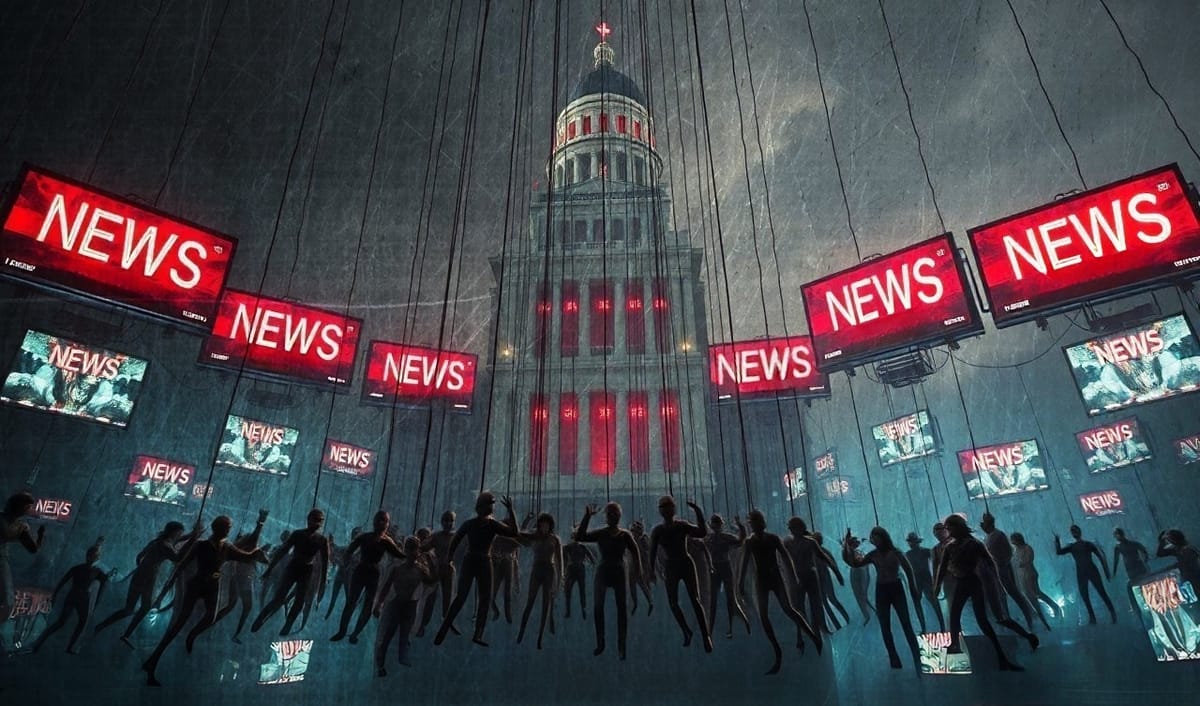
The numbers are public. Facebook’s internal research showed that divisive posts are six times more likely to be shared. Twitter’s own 2021 study admitted that its ranking system amplified right-leaning outrage more efficiently than neutral news. The algorithm doesn’t care who it lifts; it only counts how hard you react.
Each click tells the machine what to feed you next. Each shiver of outrage teaches it your taste. It doesn’t push ideology; it cultivates addiction.
We scroll through war, scandal, shootings, betrayals. We call it being “informed.” But that’s not information, it’s stimulation.
The digital bloodstream is thick with cortisol.
And every day we mistake the shaking for movement, the storm for urgency, the static for meaning.
It’s not a conspiracy; it’s arithmetic. Conflict pays. Calm does not.
The algorithm isn’t the villain. It’s the mirror we built to study ourselves, and we couldn’t look away.
The Political Marketplace…
Everything sacred eventually gets a price tag. Even rage.
Outrage now has a supply chain; mined from headlines, refined by algorithms, packaged by campaigns, and sold back to us as identity.
The red hat, the blue hashtag. Different products, same factory.
U.S. political ad spending in 2024 alone topped $12 billion, more than any midterm cycle in history. Each dollar bought another reason to hate the other half of the country. Consultants call it “activation.” Psychologists call it stress conditioning.
The networks are in on it. Cable ratings spike 30–50 percent during national scandals, then plummet when the noise dies. Crisis is their sweeps week.
Social feeds follow the same logic: the more we fight, the longer we stay.
And politicians? They’ve learned the rhythm.
Stage the outrage, tweet the condemnation, fundraise before the echo fades.
It’s not leadership, it’s product placement.
We call it discourse, but it’s retail.
The language of democracy has been repackaged as marketing copy, designed to convert moral tension into revenue streams. The snow globe isn’t cracked by accident; it’s shaken on schedule.
If you squint past the slogans, you can almost hear the machinery humming, a dull, mechanical sludge beneath the noise.
The Human Price Tag…
The storm isn’t online anymore. It’s in living rooms.
Holidays with empty chairs. Group texts that go silent.
One in four Americans now says they’ve cut off a friend or family member over politics. (Public Religion Research Institute, 2022.)
The breakups don’t look dramatic; they just calcify.
A father stops calling his daughter because she “got too radical.”
A son skips Thanksgiving because his uncle “still watches that network.”
Nobody wins. The silence metastasizes.
And beyond the personal, something subtler dies: the ability to assume good faith.
Once, a disagreement meant two people saw the world differently.
Now, it means one of them is evil.
A nation can survive poverty, disaster, even war.
It can’t survive that.
Because what’s left after empathy erodes is performance. People pretending to care, shouting moral lines into microphones while privately feeling nothing.
The data’s catching up to the feeling: loneliness and anxiety are now higher than at any point in recorded U.S. history. Social trust, measured by Pew, has dropped by half since the 1970s.
We’ve built a country where connection itself feels political.
A handshake can start a fight.
A bumper sticker can end a friendship.
A sign can get you killed.
Inside the snow globe, the air grows stale.
The flakes don’t dance anymore; they just settle in the corners like dust.
An Institutional Shield…
Every empire learns the same trick: keep the citizens busy hating each other, and they’ll forget who’s holding the purse.
While we argue about flags and pronouns, Congress trades stocks in defense contractors.
While we mock each other’s yard signs, lobbyists ghostwrite the bills that become our laws.
The outrage keeps us loud; the quiet rooms stay rich.
In 2025, corporate profits reached record highs while public trust in government hit record lows.
The timing isn’t coincidence, it’s choreography.
The institutions we once believed in learned to absorb failure without consequence. When a system can’t be held accountable, division becomes its insurance policy.
The courts delay.
The police deflect.
The press entertains.
The parties fundraise.
And the citizens? They fight.
It’s a perfect design: a feedback loop of fury where every scandal strengthens the structure it was meant to expose.
The liberal shames the conservative. The conservative mocks the liberal.
Both miss the same target.
The rot above them thrives on their noise.
We’re told the system is broken.
It isn’t.
It’s functioning exactly as built.
The glass of the snow globe isn’t cracked; it’s bulletproof.
A Wayward Out…
There isn’t a switch to flip.
No revolution hashtag, no speech to wake the sleeping, no protest to spark the apathetic.
What broke us was slow and profitable, so the repair will be slow and thankless.
But there is a path.
It starts where blame ends.
The first step is personal, not political: remembering how to doubt yourself again.
To read a headline and wonder, Who benefits if I believe this?
To hear an opinion and ask, What would change my mind?
Humility is radical now.
Listening is subversive.
And skepticism, real skepticism, the kind that cuts through your own tribe first, is the closest thing we have to rebellion.
We don’t have to agree.
We just have to re-learn how to disagree without hunger for blood.
Politics can’t save us from this sickness because politics is how we caught the disease in the first place. The antidote has to live in the spaces between people, small, unmonetized acts of decency.
The road isn’t glamorous. It’s built one conversation at a time, often in discomfort. But history’s quieter revolutions started that way: citizens choosing to stay human while the world incentivized rage.
If there’s redemption ahead, it won’t come from the institutions or the parties or the algorithms.
It’ll come from the moment you stop performing and start listening again.
The Test…
The mirror doesn’t lie, and it isn’t the enemy either.
It only shows what we’ve built; a nation shaking itself apart and calling it democracy.
We’ve turned outrage into oxygen.
Twenty-four hours a day, 365 days a year: misery, trauma, scandal, rinse, repeat.
Everyone performing awareness; almost no one discussing repair.
The fix won’t come from the parties, the pundits, or the screens.
They survive on the tremor.
It has to begin with us.
The ones still capable of speaking without shouting.
We have to unlearn the habits that keep us divided:
stop mistaking cynicism for intelligence,
stop treating cruelty as honesty,
stop building identity out of opposition,
stop confusing “calling out” with “doing something.”
And then start again, from the ground up:
start talking with people instead of at them,
start arguing in good faith, even when it stings,
start listening past discomfort,
start caring about outcomes more than victories.
Rebuild curiosity.
Reward humility.
Defend nuance.
Practice empathy like it’s a civic duty, not a personality flaw.
And we must relearn the grace of competition; how to lose, how to win, how to grow.
We must admit when we’ve been bested and not brood or seethe.
Lose with honor, knowing we gave it everything.
Don’t retreat into bitterness or self-deception; absorb the lesson, reflect, regroup.
When victory comes, take it with pride but not arrogance.
Lift the defeated, acknowledge their effort, thank them for the challenge.
Learn from those who overcame us, and teach those we’ve overcome.
That is how respect becomes culture again.
Because we’ve spent years staring at the wrong villains.
The politicians have failed.
The courts have failed.
The media profits off the carnage.
And we, the people, have failed one another.
But that failure can still be reversed.
We can choose to stop feeding the outrage machine.
We can use our exhaustion as proof that we still feel.
We can restore common sense as a shared language, not a partisan relic.
Without chaos, the powerful are nothing.
They need our division like lungs need air.
We, the people, are all we have left.
The institutions have abandoned us, but the idea of us: fallible, stubborn, capable of grace has not.
If there’s to be a revolution worth the name, it will be this:
not the shattering of the snow globe,
but the quiet, stubborn decision to stop shaking it.
You are not for sale…
#ProjectBlackbird