Transparency As a Shield...



The Epstein files were supposed to bring transparency.
Instead, they brought volume.
Millions of pages, at least according to official descriptions. A data dump so large it should have reshaped conversation overnight.
It didn’t.
No wave of accountability.
No clarity.
No moment where everything suddenly made sense.
Not even a whiff of justice.
And that raises an uncomfortable possibility:
Was this a failure of transparency…or a version of it designed not to reveal anything at all?
The Law That Can’t Enforce Itself…
Let’s put the headlines aside for a second and just look at the law itself.
The Epstein Files Transparency Act didn’t just pop into existence. This thing went through the whole machine: drafting, edits, negotiations, committees, debates, votes. The full legislative obstacle course. Which makes what it actually is a little hard to wrap your head around.
Because at its core, this law has a pretty basic problem: It doesn’t really enforce anything.
No automatic penalties if deadlines are missed.
No real consequences if someone just…doesn’t comply.
No independent watchdog making sure the rules are followed.
Instead, it basically hands enforcement back to the same fucking people responsible for following it in the first place, and if you step back for a second, that’s the kind of setup just waiting to be corrupted and exploited.
Laws are supposed to have teeth. This one feels more like a suggestion. And that’s not some tiny technical oversight buried in legal jargon. This is the end result of a process run by people whose entire goddamned job is to write laws that actually work.
So it raises a pretty straightforward question: How do you go through all of that…and end up with something that can’t even be enforced? Because lawmakers aren’t just responsible for passing laws, they’re responsible for what those laws actually do once they’re out in the world. And in this case, what they produced is a transparency law that can’t force transparency.
It can only ask for it.
That narrows things down to a much more uncomfortable question: Not whether the law failed…but whether it was even built to succeed in the first place.
Redacted…
Even if you assume everyone follows the law perfectly, there’s still another issue sitting right underneath it: Redactions.
Now, to be fair, some redactions make sense.
You don’t want to expose victims.
You don’t want to blow up active investigations.
That’s all reasonable.
The law even tries to draw a line. It says you can’t just hide things to protect someone’s reputation.
Sounds good.
But right next to that, it leaves the door open for broader categories like “victim privacy” and “ongoing investigations.”
And here’s the problem: those categories are flexible. Not wrong, just…flexible.
Because what counts as protecting a victim?
How much detail is too much?
When is an investigation actually “ongoing”?
There’s no outside referee answering those questions.
No independent reviewer. No neutral third party. The same people releasing the documents are the ones deciding what gets blacked out, and that creates a pretty simple dynamic. The people controlling the information are also controlling what you don’t get to see.
That doesn’t require some grand conspiracy to become a problem. It just requires interpretation. And interpretation gives you wiggle room. Enough wiggle room, and you can start removing context, rewriting history.
A name tied to a victim disappears. A connection tied to an investigation gets cut. Individually, each redaction might make sense. But taken together, they can quietly reshape the story you’re left with. And without anyone independent checking that work, it becomes really hard to tell the difference between what had to be hidden…and what was simply easier to delete.
Bury It in Paper…
Ok. Fine. Let’s say, for the sake of argument, everything that can be released actually is. There’s still one more problem:
Can anyone realistically work through it?
By early 2026, officials were talking about the disclosures in terms of scale, millions of pages. And at first, that sounds impressive. Like, “wow, they really opened the floodgates.” But after a second, it starts to feel a little different.
Because who’s actually reading all of that?
Not the public.
Not journalists on a deadline.
Not even Congress.
At that size, the information stops being something you can process…and turns into something you can point at.
It exists. It’s there.
But it’s not really usable.
And that’s where the real issue creeps in:
There’s no clear list of what should be included in the first place.
No master inventory. No way to check completeness. Just a massive pile of documents and the assumption that it covers everything. And that assumption is doing a lot of heavy lifting. Because if something small is missing from a small stack, you notice. If something important is missing from millions of pages?
You probably don’t.
At that point, volume starts doing the job transparency is supposed to do. Not because everything is there, but because no one can realistically prove what isn’t.
Accountability, That Reports to Itself…
Ok. Let’s say something is missing. Not hypothetically, actually fucking missing. A document that should be there isn’t. A name is redacted that shouldn’t be. Something doesn’t line up.
What happens next?
That’s where things get a little circular. Because any serious enforcement of this law ultimately runs through the Department of Justice, the same goddamned institution responsible for producing and reviewing the documents in the first place.
In other words, the system for holding the process accountable…reports back to the process itself. If Congress wants to push back, it can make noise. It can hold hearings.
It can issue subpoenas. But if it ever reaches the point of actual legal consequences, like contempt or prosecution, you guessed it, it lands right back at the fucking DOJ!
Which is kind of a dead end, ain’t it?
The same entity that would be responsible for enforcing a violation is also the one deciding whether a violation occurred in the first place. That’s not necessarily malicious. But it is a closed loop. And closed loops have a way of stabilizing themselves.
Problems don’t escalate, they get contained. Questions don’t break the system, they get routed back through it. Even if someone spots an issue, something missing, something inconsistent, the path forward isn’t clear, it’s procedural, it’s slow, and ultimately, it leads back to the same place it started.
At that point, accountability becomes less about correction and more about process. And process, on its own, doesn’t guarantee outcomes.
It just guarantees the closed loop stays closed.
I Voted for Transparency…

From a political standpoint, this law is kind of perfect. Because it lets everyone walk away looking good.
Lawmakers get to vote “yes” on transparency…on paper, that’s an easy win.
It signals accountability.
It signals openness.
It signals that something is finally being done.
And because the law itself doesn’t force hard outcomes, that vote comes with very little risk.
No sudden release of damaging information they can’t control.
No immediate fallout tied directly to the legislation.
Just the appearance of action.
That’s a pretty goddamn comfortable place to be!
You get the headline.
You get the talking point.
You get to tell constituents that you supported transparency.
And the harder questions, you know, the ones about what actually gets revealed, what stays hidden, and whether any of it leads to consequences, maybe even, God forbid, fucking justice, those get pushed somewhere else.
Usually later.
Sometimes indefinitely.
It also explains why there was so little resistance to passing it. In most cases, legislation that carries real risk, real exposure, real accountability, it creates friction. Debate. Division. Amendments.
This didn’t.
Because if a law truly threatens powerful interests, you tend to see a little pushback. When you don’t, it makes the people actually paying attention ask what exactly is the downside of supporting it? If the answer is “not much,” then the incentives start to line up pretty neatly.
Support the bill.
Take credit for transparency.
And rely on the structure of the law itself to make sure no accountability, no consequences, no fucking justice ever fully materializes.
Vapor Lock…
So, now you have a law that looks strong on paper, but it’s the timing that quietly shapes how it plays out. In this case, the timeline matters. The deadlines, the reviews, the inevitable back-and-forth over what should or shouldn’t be released, all of that shit pushes the real conflict further down the road.
Where it lands isn’t random.
It lands right in the middle of an election cycle.
And that kind of changes the tone of everything, doesn’t it?
Once you’re in that window, any attempt to push harder, be it more subpoenas, more demands, more scrutiny, it now can all be reframed instantly.
Not as oversight, but as politics.
A legal question becomes a campaign issue.
A request for accountability becomes “partisan theater.”
Once something gets labeled that way, it’s easy to dismiss, delay, or just wait out.
The closer you get to an election, the easier it is for politicians to argue that real action should wait, either to avoid influencing the outcome, or to let the next cycle deal with it, and by the time that next cycle arrives, the urgency has usually faded.
Attention moves on.
Priorities shift.
The moment passes.
The people in these files keep slithering free.
The media, well, they have a new crisis for their abattoir, and if they don’t, they’ll just make one up.
The Audit Trail of Tears…
Everything comes down to how the system works; how laws are written, how documents are released, how information is filtered, but there’s another possibility sitting just outside that’s not about the process, but about the starting point.
All of this assumes that the documents going into the system are even complete to begin with, and that’s not something the public can fucking verify.
In 2025, lawmakers raised concerns that portions of the Epstein-related material may have already been “scrubbed” at the FBI level before ever reaching the DOJ. That doesn’t mean there’s a clear before-and-after you can point to, no side-by-side comparison, no obvious “this used to say something else.”, and that’s what makes it shady.
If something is removed early enough, before it enters the formal review and release process, then everything that comes after can still look completely legitimate. The DOJ can follow the rules, lawmakers can review what they’re given, the public can be told the process was handled correctly, and all of that can be true, while still being based on a version of the material that’s already been culled.
Look at it like this; if you’re handed a stack of documents and told “nothing has been removed,” that statement only holds up if you know what the original stack looked like. If you don’t, then you’re taking completeness on trust, and trust is doing a lot of fucking work here.
Once information disappears early in the chain, it doesn’t leave a gap you can actually see. There’s no missing page number, no placeholder, no obvious sign that something should be there and isn’t.
It just… never shows up.
And the rest of the process, no matter how carefully it’s followed, operates on a version of events that may already be wrong.
It’s not just about what was released, or how it was redacted, or how much of it there is, when it’s far more basic than that. If the starting point isn’t visible, then everything built on top of it is skewed, so how does one figure that’s transparency?
Size Matters…
How much fucking material are we really talking about?
Because the public conversation has centered on “millions of pages,” there are also references from lawmakers to much larger amounts. Something closer to hundreds of terabytes.
Not exactly the same.
In one sworn account, an FBI official described a dataset measured in the hundreds of terabytes, with portions recovered and others reportedly lost. Even recently, members of Congress have continued to refer to “terabytes” of records still being withheld.
So, you know, exactly the definition of transparency, right?
I mean, if you can’t clearly define the size of the dataset, you can’t clearly define what “complete” is supposed to look like, and without anyone being able to say whether it represents what exists, most of what exist, or just a fraction muddies the water, when a legitimate, well-framed piece of legislation should make these details…clear.
Presumption of Proof…
And, yeah, people fuckin’ noticed. The criticism started to get loud, and the last thing people at the DOJ, namely Pamela Jo Bondi, is people asking them questions, because Pamela Jo does not do questions.
A response was needed. So, Pamela Jo offered one.
Lawmakers were invited to review unredacted files in person. Now, on paper, that sounds like transparency, but in practice, it looked a little different. Bondi made sure any review was limited to a handful of “secure” computers, reportedly just a few terminals for millions of documents.
No phones.
No laptops.
No external devices.
No copies allowed.
You could read what was there, but you couldn’t actually prove that you did.
At that scale, even reading the shit became its own problem. Some estimates suggested it would take years to go through everything available under those conditions, and if there are indeed terabytes of data…yeah, not happening.
So, great! Access exists…technically, but it’s limited in a way that makes it almost unusable, and if a lawmaker sees something important, they can’t even fucking document any of it.
Now the burden shifts. Instead of evidence, you get descriptions. Instead of documentation, you get statements, and statements are really easy, in this post-truth, alternative facts hellscape we live in, to dispute, dismiss, and ignore.
This isn’t a tool for accountability; it’s a controlled experience, and a suppressed narrative. You’re allowed to look. Just not in a way that changes anything.
Transparency isn’t just about seeing information; it’s about being able to fucking use it.
This isn’t misunderstanding the EFTA, it’s not accidentally muddying the waters, it’s dredging the entire waterway and dumping it into a blender.
Profiting Off the Backs of Victims…
If a system creates incentives, those incentives don’t stay theoretical.
They show up in behavior.
And in this case, they do.
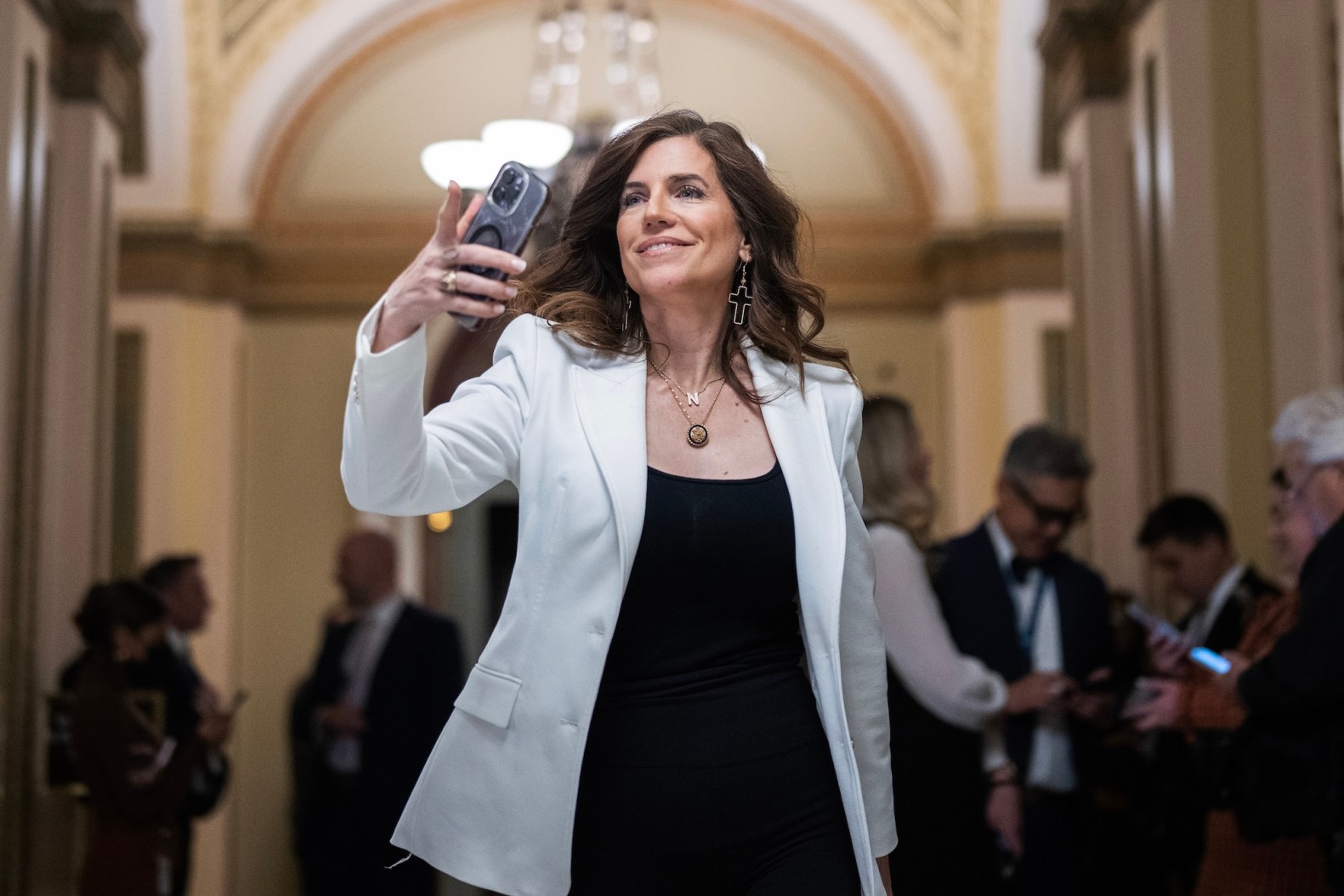
Nancy Mace (R-SC)
In the second half of 2025, Representative Nancy Mace’s fundraising rose sharply alongside her public push for the Epstein Files Transparency Act.
During an eight-week stretch in Q3, her campaign reported raising roughly $1.1 million, driven largely by small-dollar donations.
That momentum continued into Q4, with over 20,000 individual donors and an average contribution of around $25.


During that same period, she launched her campaign for governor of South Carolina.
Her messaging consistently emphasized accountability and transparency, with the Epstein files positioned as a central example of both.
The donor base wasn’t confined to her state.
Much of it was national, suggesting the issue had become a broader organizing and fundraising mechanism.

Thomas Massie (R-KY)
Representative Thomas Massie’s approach followed a different style, but a similar pattern.
In Q3 of 2025, his campaign raised approximately $782,000, his strongest quarter on record, which he linked directly to his efforts to force the release of the files.
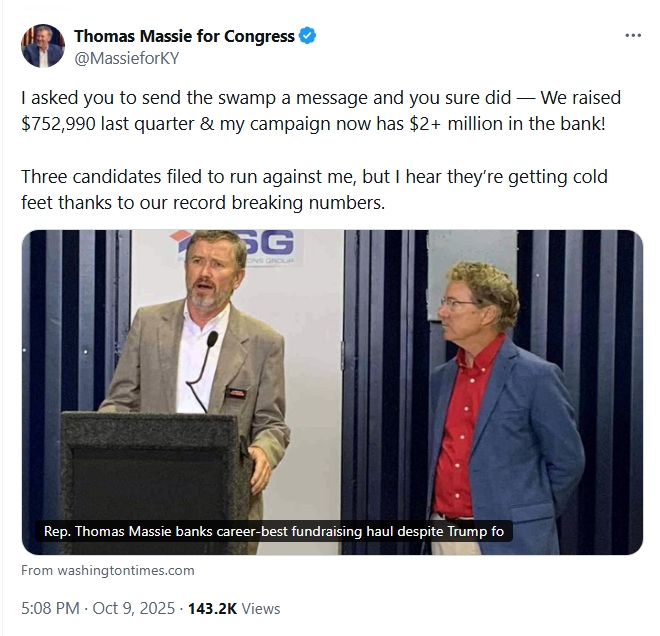
His public framing positioned opposition to disclosure as coming from powerful interests, and that framing carried into donor messaging.
When outside groups spent heavily against him, those efforts were presented as evidence that his position was effective.
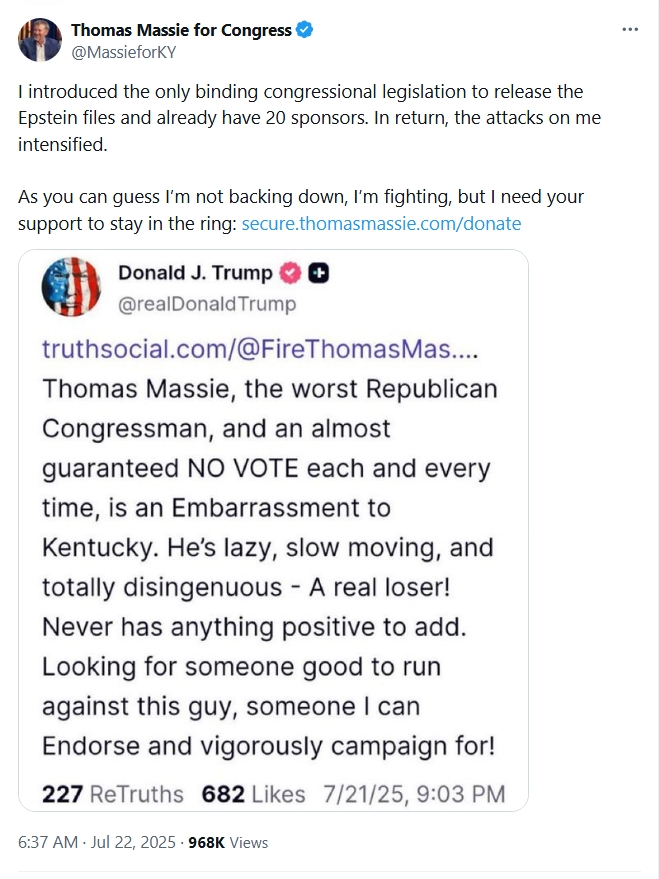
His ongoing conflict with the Department of Justice, through public statements, oversight activity, and threats of contempt, became a recurring part of that messaging cycle.
We want to separate this from everything above.
Everything up to this point has been structure, process, and observable behavior.
This isn’t that. This is what it leaves us with.
When you look at all of it together, it’s hard not to notice how cleanly everything fits. Not clean in the sense of neat or orderly, but clean in the sense that nothing really disrupts anything else.
The law doesn’t force action.
The process allows discretion.
The volume prevents verification.
The access limits proof.
The incentives reward continuation.
And the outcome… stays open.
I don’t think you need a conspiracy to explain that.
You don’t need coordination.
You don’t even need bad intent across the board.
Systems don’t have to be malicious to produce results like this. They just have to be built in a way where nothing requires them to resolve anything, and maybe that’s the part that sticks in our throats the most, not what’s in the files, not who might be named, not even what may or may not have been withheld, but the fact that, at every step, the burden seems to move away from the people with the information, and toward the people trying to understand it.
You can read what’s available.
You can follow the process.
You can watch the hearings.
You can track the statements.
But at no point are you given a clear way to answer the only questions that really matter:
Is this everything?
Is this all just performative bullshit, carefully planned and coordinated, by both Republicans and Democrats, both parties knowing fully-well that this slots into an election year perfectly, so that they could all advance their careers, raise more money, and perhaps hurt their enemies, perceived and real?
Yes, it is.
There is no transparency.
There has been no real release of these files.
No one has been held accountable.
No one has been arrested, in America at least.
No victim has received any semblance of justice.
And without any consequences written into this waste of time, money, and energy, a waste that has traumatized many, and re-traumatized the victims, and with the only possible shred of accountability being a referral for contempt, that will land on the desk of a bitch who we already know is connected to Jeffrey Epstein, and Donald Trump, then the unknowns are not quantifiable.
But we do know this:
The only way you will ever truly learn which high-ranking government officials, (of all parties and it does involve the entire scope of politics, Hollywood, business and beyond), ultra-wealthy pricks, politicos, and other gutter trash like to rape, torture and abuse kids is if this backed up septic tank they call a government accidentally exposes them, and given the depths of their depravity, vanity and stupidity, that might just happen.
Yes, it is a cover-up, and unless drastic, merciless, and ruthless measures are taken to uncover it?
It will always be…
You are not for sale…
#ProjectBlackbird