Why This Death?


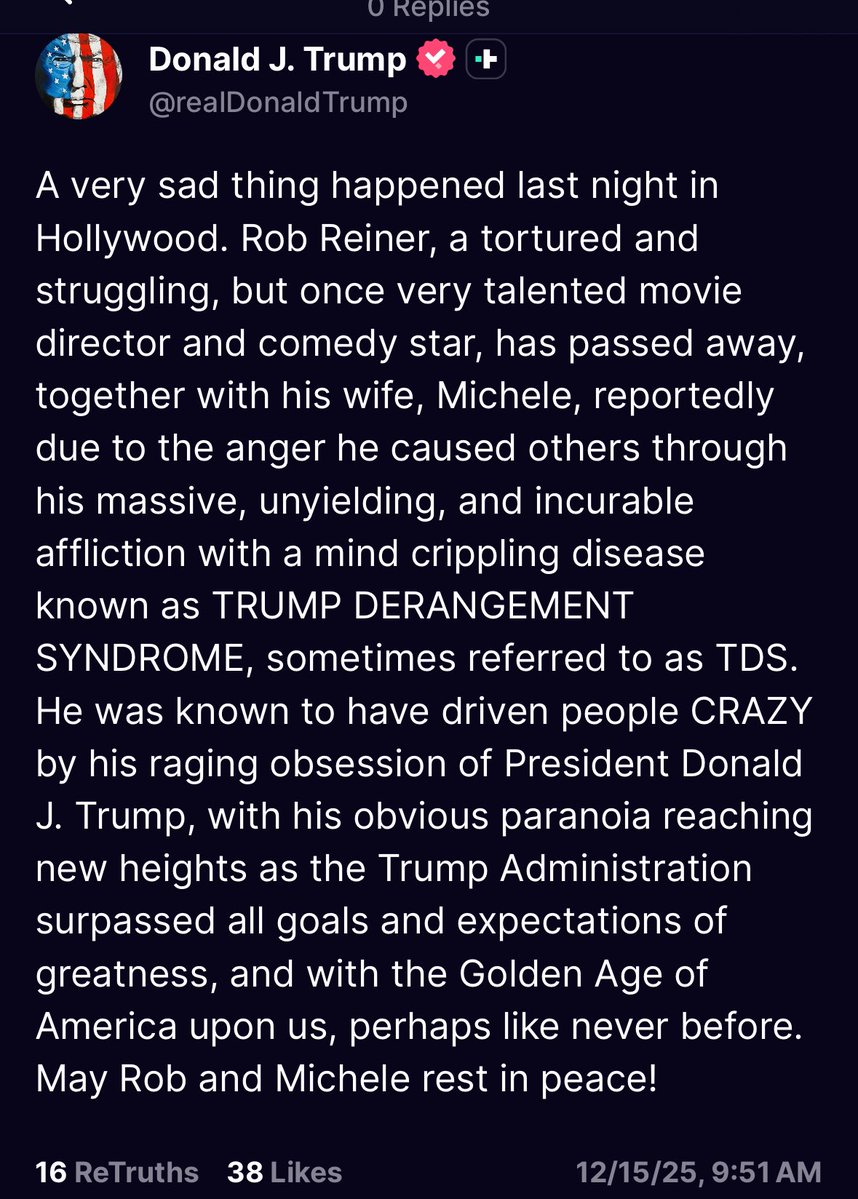
The Silence That Came Before It…
Donald Trump has never shown much inclination toward the rituals of mourning.
Public deaths tend to pass him by without remark. Soldiers killed abroad. Police officers murdered at home. Former presidents. Moments that ordinarily invite restraint, if not reflection. Trump’s response is usually silence, not a dignified silence, exactly, but a kind of disinterest. One gets the sense that if a moment cannot be personalised, it barely registers.
Which is why his decision to comment on the death of Rob Reiner is, in its own way, rather striking.
Not because the post is shocking — it is entirely on brand — but because it exists at all. Trump is nothing if not predictable, and when predictable people depart from habit, it is worth asking why.
Something about this death warranted attention. That alone is suggestive.
There is no grief in the post, nor any serious attempt to simulate it.
Rob Reiner’s death is treated less as a conclusion than as a pause — a brief stillness into which Trump steps with noticeable ease. Reiner’s work and life receive only cursory acknowledgement before the focus returns, quite naturally, to Trump himself: his administration, his supposed achievements, his grievance with those who declined to admire him properly.
Death, in this telling, is not loss.
It is opportunity.
Trump does not meet silence with contemplation. He fills it. And when the subject of that silence is no longer able to respond, the filling becomes more assured, less encumbered by restraint.
“Once Talented”…
Trump refers to Rob Reiner as “once talented,” a phrase that at first glance appears merely dismissive. In fact, it is far more revealing.
In psychological terms, this is a status-reduction maneuver, an attempt to retroactively lower the standing of a person whose stature could not be controlled while they were alive. The phrasing does not simply criticize; it reorders time. Talent is relocated safely to the past, where it can no longer compete.
This pattern is common among individuals for whom self-worth is comparative rather than internal. Achievement is not something that exists on its own; it is something that must be ranked. And critics who possess enduring cultural legitimacy present a particular problem, because they do not require proximity to power to remain relevant.
Rob Reiner’s work did not need Trump’s approval.
Calling him “once talented” is an effort, unconscious, perhaps, to suggest that relevance itself had expired.
It had not.
That is precisely the difficulty.
“Trump Derangement Syndrome”…
The invocation of “Trump Derangement Syndrome” follows a familiar script.
This phrase functions as a form of defensive externalization. It reframes criticism not as judgment, disagreement, or moral evaluation, but as illness. The critic is no longer a thinking agent; they are a patient. Their objections need not be addressed, only dismissed.
A maneuver serving as a protective apparatus for the brand, and for the ego. If opposition is pathological, then Trump himself never has to be meaningfully evaluated. He is not rejected; he is misunderstood. He is not judged; he is obsessed over.
Yet behavior matters more than labels.
Trump did not need to comment.
He did not need to diagnose.
He did not need to revisit the relationship at all.
He chose to do so after death, when rebuttal was impossible. That choice strongly suggests not indifference, but unresolved narcissistic injury; the lingering discomfort of having been evaluated by someone whose judgment could not be coerced, dismissed, or reclaimed.
Trump’s continued reference to himself in the third person is a habit so familiar it is often overlooked, and is frequently associated with self-distancing combined with self-mythologizing. It allows the speaker to present themselves as an object, a figure to be discussed, admired, or resisted, rather than as a participant in a mutual exchange.
In Trump’s case, this serves two functions.
First, it elevates the self into something closer to a brand or institution, insulating it from ordinary interpersonal judgment. Second, it allows Trump to narrate his own importance as though it were an established fact, rather than a claim requiring validation.
Notably, this rhetorical distancing intensifies in moments of perceived threat or rejection.
Rob Reiner did not reject Donald Trump the man.
He rejected Trump, the figure.
The third-person framing attempts to stabilize that figure after the fact.
Seen through this lens, the choice to comment becomes clearer.
Rob Reiner was not merely critical. He was independent, unimpressed, and permanent. His disapproval did not require explanation, and it did not soften with time. It did not seek resolution.
And, Reiner could not be bought.
Trump has always managed opposition that eventually tires or negotiates. What appears to unsettle him most is opposition that simply remains, not angry, not obsessive, just unmoved.
Death did not soften that rejection.
It fixed it in place.
The post reads less like an attack than like a final, belated attempt to reorder a hierarchy that never bent in life.
Validation = Currency…
There is, running beneath this post and much of Trump’s public life, a pronounced dependence on formal validation.
Not approval in the abstract, and certainly not quiet respect. Not admiration, exactly. Not affection. What Trump seeks are recognitions that arrive with ceremony; awards that can be named aloud, titles that can be repeated, honors that can be displayed. Esteem, to be felt, must be conferred, preferably by an institution and preferably in public.
This explains a long trail of curiosities: the inflation of minor accolades into grand honors; the persistent fixation on prizes he did not receive; the peculiar agitation surrounding the Nobel Peace Prize, an agitation made more pointed by the fact that Barack Obama was legitimately awarded one. The irritation was never subtle. It had the air of someone watching a door close that they had assumed would open for them by default.
What matters psychologically is not envy so much as comparison. Trump does not experience awards as acknowledgments of others’ work; he experiences them as judgments rendered against him.
Trump has never been meaningfully honored for his most famous work.
Which brings us to an awkward fact Trump has never managed to resolve.
For all its visibility, The Apprentice was not honored in the way Trump plainly believes it deserved to be. It generated attention, ratings, and profit, but not esteem. It did not earn the industry’s respect, nor did it accumulate the awards that signify something more durable than popularity. It was garbage television. Television viewers watched because it was garbage.
Trump is acutely aware of the distinction.
So are his critics. Figures he openly despises (Jimmy Kimmel, Rob Reiner) have accumulated the sort of recognition that arrives unbidden: peer awards, lifetime honors, institutional respect. They did not need to demand these things. They were offered.
To someone whose sense of worth is internally secure, this difference is unremarkable.
To someone now dependent on external validation due to a childhood of parental absentia,, it is a recurring humiliation.
Every award they receive becomes a reminder of one he did not. And, every time they are declared winners, it is a reminder that he…is a loser.
After Death…
Seen this way, Trump’s post reads less like an insult than like a reflex.
Rob Reiner died having been honored for his work, not universally adored, not beyond criticism, but respected in a way that requires no insistence, no threats, and no tantrum. Trump, confronted yet again with that contrast, responded in the only way his Alzheimer’s-riddled brain could: by attempting to diminish someone who was no longer able to fire back.
Reiner did not need to list his accomplishments. They were listed for him, which is why Trump must still insist. Calling him “once talented” is not criticism. It is an attempt to demote a rival in a hierarchy Trump feels he has been unfairly excluded from, a hierarchy he does not belong to, of which he is fully aware..
Death did not erase that imbalance.
It merely removed the possibility of contradiction.
It is not simply an insult delivered too late. It is a reaction to a life that concluded with something Trump has never possessed: honor. Not notoriety. Not attention. But respect conferred by institutions Trump covets and resents in equal measure.
This is why the post carries such a sharp, atypical, and unsettled tone.
It is the irritation of someone confronted, yet again, with the fact that some people are honored because they are respected, because people genuinely like them, not because they demanded it.
Trump, believing he was the only voice speaking, tried, and as he has done with everything throughout his life, he failed.
But this time, people aren’t listening. They are not interested, and, they are not as concerned with the bleating of an anemic sheep.
You are not for sale…
#ProjectBlackbird
J \ L