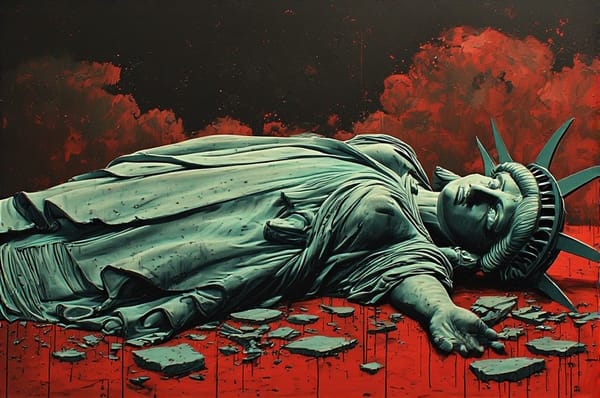
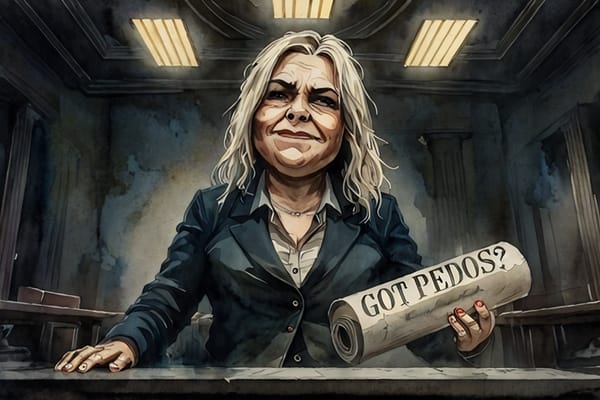
The Supreme Court: Justice in Drag...


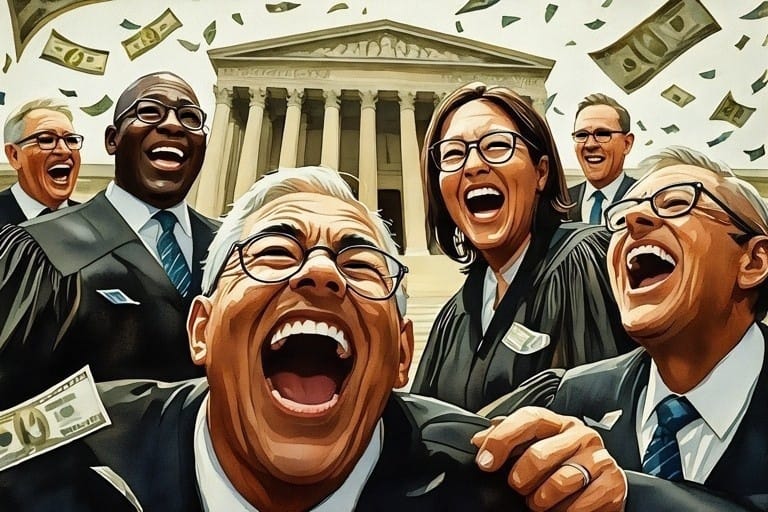
Alexander Hamilton once called the Supreme Court the “least dangerous branch.” That’s cute, ain’t it? Like calling a bottle of whiskey the “least dangerous drink” at an Irish wake. Hamilton thought judges would just sit around reading law books and playing constitutional Sudoku while the “real” branches ran the country. Instead, the Court evolved into a nine-person demolition crew for whatever social progress one faction doesn’t like.
Congress is a toddler’s toy chest, flipped over and scattered every two years. The presidency is a reality TV game show, where sometimes the prize is health care reform and sometimes it’s a nuclear codes handoff to a retarded hobgoblin with early-onset dementia. But the Supreme Court? That’s the one prize that doesn’t expire. Once you’re on the bench, you’re there until you die, resign in disgrace, or retire once the check clears. It’s not a job; it’s a hostage situation where the hostage is democracy.
The average justice used to stick around for about 15 years. Now it’s closer to 30. That means one successful Senate confirmation can outlast the lifespan of your marriage, your mortgage, and at least three different versions of the iPhone. It’s basically political cryogenics.
This is why the Court matters more than anything else in American politics. You don’t need to win the messy popularity contest of democracy if you can stack the bench with ideological mannequins who will flatly echo your worldview long after you’re gone. Convince 51 senators once, and congratulations; you’ve installed a constitutional cheat code that can’t be voted out.
So when Hamilton called the judiciary the “least dangerous branch,” he wasn’t just wrong. He was laughably, dangerously, oh-sweet-summer-child wrong. The Court is the most dangerous branch precisely because it doesn’t have to answer to anyone. It’s not the umpire of democracy, it’s the rigged slot machine, designed to pay out only for the house.
The Plantation PR Firm…
The year was 1857, and America was already one big tinderbox soaked in kerosene. Enter the Supreme Court with a lit match. Dred Scott v. Sandford wasn’t just a case; it was the judiciary cosplaying as the White Citizens’ Council.
The question: could Dred Scott, a Black man who had lived in free states, sue for his freedom?
The answer: a hard no, delivered with all the smugness of men who thought powdered wigs made them philosophers.
Chief Justice Roger Taney’s majority opinion basically rewrote the Constitution into the Plantation Owner’s Handbook:
- Black people, enslaved or free, could never be citizens. Ever. Full stop.
- Enslaved people were “property,” and the Fifth Amendment apparently protected the sacred right to buy, sell, and whip them.
- Congress? Powerless to restrict slavery in the territories. Goodbye, Missouri Compromise. Hello, nationwide nightmare.
This wasn’t “interpreting the Constitution.” This was the Court auditioning for a job as Jefferson Davis’s interns.
The South popped corks and called it divine providence. Dred Scott was their golden ticket, proof that the Constitution itself was just a ledger for their human property. They cheered, they preened, and no doubt some slave auctions had a “Taney Discount Day” just to rub it in.
The North? Pure acid reflux. Even people who weren’t abolitionists were nauseated. If slavery was now protected everywhere, compromise was officially dead. The idea of “half-slave, half-free” America had just been declared unconstitutional.
Northern states didn’t wait around to send a strongly worded letter with a Chuck Schumer seal of approval on it. They passed “personal liberty laws” designed to nullify the ruling. Translation: Thanks for your opinion, Supreme Court, but we’ll be over here ignoring it.
Half the country flipped the Court the bird. The other half used the decision as a license to keep grinding human beings into wealth.
Let’s not sanitize who made this decision. These weren’t nine impartial sages; they were the julep mafia, men with plantation interests dripping from their robes:
- Roger Taney (Chief Justice, Maryland): Freed his own slaves but never freed his skull from white-supremacist rot. His opinion is a greatest-hits album of bigotry.
- James Wayne (Georgia): A slaveholder who treated jurisprudence like an auctioneer’s handbook.
- John Catron (Tennessee): Thought congressional bans on slavery were unconstitutional, because apparently freedom itself was unconstitutional.
- Peter Daniel (Virginia): The kind of racist who would probably sue his dog if it barked at an abolitionist.
- Samuel Nelson (New York): A Northerner in geography, a Southerner in spine.
This wasn’t a neutral court. It was a plantation board of directors. Imagine nine men in robes, sipping mint juleps, solemnly deciding whether millions of human beings were property or people. Spoiler: they chose property.
The Death of Compromise
Instead of clarifying the law, Dred Scott obliterated the last scraps of middle ground. Northerners saw the ruling as proof that the Court was just the slavocracy’s hand puppet. Southerners saw it as a blank check to expand slavery westward, maybe even into free states.
Lincoln, still on the political rise, nailed it in his 1858 House Divided speech: “This government cannot endure, permanently half slave and half free.” What he didn’t have to spell out was that the Supreme Court had already chosen which half should win.
The Court didn’t settle the slavery debate. It rigged the scoreboard, handed the South a trophy, and told the North to smile while they got clubbed.
Rage-Quitting with Cannons…
The Original Snowflakes
The South adored Dred Scott. It was their golden goose, their constitutional security blanket, their “you’ll never take our toys” card. But the second Abraham Lincoln won the 1860 election, they had a collective titty-baby meltdown. He wasn’t even calling for abolition just “no new slave states.” But to the Southern planter aristocracy, that was the apocalypse.
So what did they do? They rage-quit the Union like petulant spoiled children flipping the Monopoly board because they landed on Boardwalk. Only instead of sulking in the corner, they armed themselves and wrote florid secession declarations about how oppressed they were for not being allowed to own human beings in perpetuity.
Don’t take our word for it; the states put their tantrum in writing. South Carolina’s secession declaration raged about Northern states refusing to enforce the Fugitive Slave Act. Translation: They’re not helping us kidnap escaped Black people, so we’re leaving.
Mississippi’s declaration was even less subtle: “Our position is thoroughly identified with the institution of slavery: the greatest material interest of the world.” That’s not a political philosophy. That’s a press release for human trafficking.
Texas, never one to be outdone in the dumbass bigot department, whined about “the debasing doctrine of equality of all men.” Yes, you read that right: equality was “debasing.” These documents weren’t constitutions. They were therapy sessions for slaveholders terrified of Black people using the same shitter that they did.
The South had just won the biggest judicial victory in history with Dred Scott. The Supreme Court had validated their entire worldview. But the second they realized Lincoln could appoint justices who might eventually reverse it, they said: “Fuck you and your system. We out.”
That’s not principled resistance. That’s mob bosses quitting the casino because the dealer might not cheat for them forever.
By seceding, the South didn’t just defy Congress or Lincoln. They defied the Supreme Court itself. They declared that federal authority, rulings, laws, the whole deal, no longer applied to them. It was the nuclear option of legal defiance: when you can’t control the ref, you burn down the stadium.
The War of Fragile Egos
And so, instead of living in a country where slavery might one day be put on the political chopping block, they chose civil war. Six hundred thousand dead, a nation shattered, all because a wealthy planter class couldn’t imagine life without a captive labor force to whip, rape, and lynch.
These men weren’t patriots defending liberty. They were billionaires of their day, fighting to keep their human stock portfolios intact. Strip away the flowery language about “states’ rights,” and it’s just crusty white plantation tycoons having bitch fits because autonomy threatened their dividends.
Secession taught us something ugly but essential: when one faction makes the Supreme Court its personal fortress, and then fears losing control of it, they don’t back down gracefully. They torch the whole goddamned system.
In the 1850s, that meant cannons at Fort Sumter. In the 2020s, it meant Mitch McConnell turning the Senate into a hostage chamber to block one nominee and ram through another. Different weapons, same agenda.
The Federalist Factory…
The 1950s and 1960s were a conservative fever dream. The Warren Court was spitting out rulings like a rights-dispensary vending machine:
- Brown v. Board (1954): Segregated schools, unconstitutional. Cue Southern governors sweating through their cigars.
- Gideon v. Wainwright (1963): Even poor defendants get lawyers. Shocking, I know.
- Miranda v. Arizona (1966): Police have to tell you your rights. Cops everywhere muttered “buzzkill.”
- Engel v. Vitale (1962): No state-sponsored school prayer. Jerry Falwell fainted.
To conservatives, this wasn’t justice. It was heresy. So, instead of politely losing, they built an army.
Richard Nixon rode into power in 1968 promising “strict constructionist” judges, which was code for people who won’t make us integrate lunch counters or stop frisking hippies. He appointed four justices, including William Rehnquist, a man whose idea of constitutional interpretation looked suspiciously like segregationist porn.
Nixon’s move was clear: if the Court could wreck your hateful dogma, you make it your Court. Why lobby when you can legislate from the bench with a robe and a gavel?
By the 1980s, conservatives had perfected the machinery. In 1982, the Federalist Society, founded at elite law schools as a conservative counterweight to all those dirty, radical liberals quoting the Bill of Rights like it mattered.
The “FedSoc,” as insiders disdainfully call it, became the Hogwarts of right-wing jurisprudence; only instead of teaching spells, it taught “originalism,” the idea that we should interpret the Constitution as if we’re still wearing powdered wigs and hunting witches in Salem. It sounds noble until you realize it’s just a pretentious way of saying: freeze society at a time when only rich white assholes had a say. Rich white asshole men, specifically.
Reagan stacked his administration with FedSoc-approved legal talent. Judges like Antonin Scalia, the sharp-tongued high priest of originalism turned the philosophy from law school cosplay into Supreme Court doctrine. Clarence Thomas, Scalia’s protégé, carried the banner forward like a knight sworn to protect 18th-century prejudices forever, when he wasn’t violating Anita Hill, and god knows how many other women, or engaging in his favorite pastime: “Here’s My Pubic Hair!”
The Federalist Society wasn’t just ideas. It was logistics. It built a conveyor belt:
- Recruit conservative law students.
- Place them in clerkships with conservative judges.
- Graduate them into think tanks, law firms, and federal benches.
- Promote them when vacancies appeared.
- By the time they reached SCOTUS shortlists, they were already housebroken.
No surprises. No swing votes. Just reliable ideologues cosplaying as neutral arbiters.
Meanwhile, Democrats were treating judicial nominations like a summer internship program. Bill Clinton appointed moderates (Ginsburg and Breyer) who were respected, brilliant, but not the kind of ideological warriors Reagan and Bush were pumping out. Democrats wanted balance. Republicans wanted dominance.
Guess who wins that tug-of-war?
The Moment the Mask Slipped
Then came December 2000. Bush v. Gore. Five conservative justices decided, effectively, who would be president. Their reasoning? Legal spaghetti so incoherent they explicitly told future courts not to cite it as precedent.
The message was clear: the Court wasn’t just willing to dabble in politics; it was willing to pick the president. At that point, the illusion of impartiality was dead. The Supreme Court was openly a partisan actor in robes.
By the time Reagan’s justices had finished their long tenure, conservatives knew the playbook worked. Judicial capture wasn’t an accident, it was a renewable resource. With each administration, the GOP doubled down on the Court as its final fortress. Not just to slow change, but to lock in an ideology immune from elections.
Because why risk losing in Congress when you can stuff your back-ass-wards ideology into the Constitution with a single vote in the Senate?
Mitch McConnell: Trump’s Ace in the Hole…
Mitch McConnell doesn’t smile much, but when he does it’s usually because he’s just executed a procedural carjacking. His magnum opus came in 2016, when Justice Antonin Scalia died and Barack Obama nominated Merrick Garland. McConnell refused to even hold a hearing - not a debate, not a vote, not even a polite throat-clearing. His excuse? “Too close to an election.”
Here’s the math: Garland was nominated in March. The election was in November. That’s eight months of “too close.” By that logic, every president is only allowed to nominate a justice in their first year, and the rest of the term is a judicial waiting room. But McConnell didn’t care about logic. He cared about outcome: keeping the seat warm for a Republican president. A Republican president that Mitch McConnell knew was going to win in November. Why? How? Russia, that’s why, that’s how.
In 2022, Philadelphia Inquirer columnist Will Bunch published an article titled “Inside McConnell’s tie to indicted Putin ally” and in that article it laid bare McConnell’s Russian soft-spot:
Last week, the U.S. Justice Department announced the indictment of billionaire Russian aluminum magnate Oleg Deripaska, for his efforts to evade U.S. sanctions that were personally imposed on the oligarch in 2018 over his ties to Putin, his profiting from the dictator’s unlawful seizure of Crimea from Ukraine in 2014, and his business practices that include bribery, extortion, and, allegedly, murder-for-hire. The criminal charges assert that Deripaska and two allies plotted to evade the sanctions so that his girlfriend could birth their child on U.S. soil and the oligarch could buy a California music studio, among their various schemes.
Later in the article:
In January 2019, McConnell — then the Senate majority leader — used his clout to muster just enough GOP votes to kill a Democratic bill meant to block the Trump administration from lifting sanctions on the Deripaska-led aluminum conglomerate, Rusal, and related companies. The Washington Post reported that McConnell’s legislative victory came at almost the same time that an American entrepreneur named Craig Bouchard was cementing a deal for Deripaska’s Rusal to take a 40% stake in a new U.S. aluminum plant that would be built in McConnell’s Kentucky.
And:
Whatever games Deripaska was playing around the sanctions, the Kentucky plant — which at least would have brought some jobs to McConnell’s depressed Appalachian state — was never built.
But immigrants that aren’t pale white vampires having babies here for citizenship are the real enemy, huh?
Fast-forward to 2020. Justice Ruth Bader Ginsburg dies six weeks before the election. Suddenly, the rule is different. McConnell and gang rams Amy Coney Barrett through confirmation faster than a Domino’s delivery. The justification? “We control the Senate, and the White House.” Translation: We make the rules, and the rules are whatever gets us what we want today.
And let’s be real here, this wouldn’t be the first (or last) time Amy Coney Barrett was rammed by a room full of men.
The hypocrisy wasn’t subtle. It was the point. McConnell wasn’t trying to look fair. He was demonstrating that fairness was dead. He’d replaced the Senate’s advice-and-consent role with a new system: obstruction when Democrats hold the White House, warp speed when Republicans do.
To grease the wheels further, Republicans detonated the “nuclear option,” lowering the confirmation threshold for Supreme Court nominees from 60 votes to a simple majority. No more bipartisan consensus. No more moderates. Just raw majority muscle. Whoever holds the Senate floor, holds the Court.
This wasn’t just hardball. It was ripping up the rulebook and burning it in front of C-SPAN cameras and their 14 viewers.
Donald Trump, the least disciplined president in modern history, became the GOP’s most effective Supreme Court packer. Not because he cared about jurisprudence, Trump couldn’t tell “originalism” from “oregano”, but because the Federalist Society spoon-fed him a pre-vetted list. All he had to do was read the names off a teleprompter, if the United Nations didn’t secretly sabotage them.
Three vacancies, three confirmations: Neil Gorsuch, Brett Kavanaugh, Amy Coney Barrett. Just like that, the Court tilted 6–3 conservative, the strongest right-wing majority since before the New Deal.
For a man who burned through cabinet secretaries like Adderall prescriptions, Trump’s judicial picks were disturbingly durable. The justices he appointed will be reshaping law long after his bankrupt golf courses have been repossessed, and long after his cheap, Chinese made flea market merch is poisoning landfill soil.
McConnell and Trump together delivered what decades of conservative strategy had built toward: an ideological supermajority. Not balanced. Not moderate. Not even hiding its stripes anymore. A Court designed to outlive Republican electoral losses and keep enforcing Republican priorities regardless of public opinion.
And it worked. Within two years, Dobbs gutted Roe v. Wade, Bruen supercharged gun rights, West Virginia v. EPA kneecapped regulators, and affirmative action went up in smoke. Campaign promises Republicans could never fully pass in Congress became binding law through judicial fiat.
McConnell’s goiter genius was realizing that norms are only as strong as the willingness to be embarrassed when you break them. He simply stopped being embarrassed. And one of the very few things Trump actual excels at was handing his judicial shopping list to the people who’d been planning this for 40 years.
The GOP didn’t just capture the Court. They installed a generator in the basement and welded the doors shut.
The Three Stooges…
The Supermajority Nobody Voted For
Trump’s three justices are the crown jewels of the GOP’s 40-year capture campaign. Think of them as ideological nesting dolls: each one carefully crafted, hollow enough to be filled with talking points, and guaranteed to sit on a shelf for decades. They weren’t chosen for brilliance or moderation. They were chosen for loyalty and corruptibility.
Neil Gorsuch: The Cowboy Philosopher of Corporate Power
- Polished, polite, wears his originalism like a Patagonia vest; practical, corporate-friendly, and utterly predictable.
- Handpicked from the Federalist Society catalog. His rulings tilt heavily toward corporate interests, employers, and anyone with more money than conscience.
- Consistently narrows worker protections, broadens corporate immunity, and treats regulation like an invasive species.
- Gorsuch is the judicial equivalent of a luxury SUV: expensive-looking, smooth on the surface, but designed to run over the environment while sipping artisanal coffee.
Brett Kavanaugh: The Beer & Rape Enthusiast
Frat bro who somehow wandered into a lifetime gig. His confirmation hearing was less about jurisprudence and more about keg stands and temper tantrums.
- Long-time GOP operative, Whitewater investigation alum, Bush-era staffer. A partisan soldier with a judge’s gavel.
- Loyal to conservative orthodoxy, but tries to cloak it in “moderate” language. Always willing to rule against labor, regulation, and women’s autonomy if it keeps the party happy.
- Kavanaugh’s legacy will be proof that you can cry about your calendars in front of Congress, scream about liking beer, and still be rewarded with a job where you decide the fate of 330 million people. Truly, the American Dream.
Amy Coney Barrett: The Gangbang Handmaid
- Smiling suburban mom who got fast-tracked through confirmation like a Supreme Court DoorDash order. Nominated weeks before an election, confirmed faster than you can microwave popcorn.
- Staunch Catholic, originalist disciple, zero qualms about turning precedent into compost.
- Consistently votes to unravel abortion rights (Dobbs), weaken regulatory power, and enshrine conservative dogma.
- Barrett isn’t a justice so much as the Federalist Society’s prom queen: plucked from obscurity, crowned overnight, and expected to smile while gutting half a century of women’s rights.
Together, Gorsuch, Kavanaugh, and Barrett form the solid spine of the 6–3 supermajority. They’re not wildcards. They’re not swing votes. They are the proof of concept: three ideological soldiers in robes, appointed not to interpret the Constitution neutrally but to entrench a worldview by judicial fiat.
They didn’t arrive to deliberate. They arrived to deliver.
The Receipts…
The conservative majority swore during their confirmation hearings that Roe was “settled law” and that they “respect precedent.” Cut to a few years later, and “settled” apparently meant “settled until we can knife it.” What followed wasn’t impartial law. It was the Federalist Society’s Christmas wishlist wrapped in bondage leather and Viagra logos.
Dobbs v. Jackson Women’s Health Organization (2022)
Roe v. Wade, gone. A half-century of constitutional protection for abortion flushed in one ruling. States immediately launched abortion bans like they were firing starter pistols. In fact, many had this legislation already locked and loaded well before the ruling. Almost as if they…knew. Women’s rights, reproductive autonomy, and healthcare access detonated overnight.
The majority argued they were “returning the issue to the people.” Translation: handing it to gerrymandered state legislatures run by men who think Fifty Shades of Grey is a how-to manual.
New York State Rifle & Pistol Association v. Bruen (2022)
Gun rights expanded. Concealed carry restrictions in New York struck down. The new standard: laws regulating guns must align with “historical tradition.” Good luck passing any modern gun safety law unless you can find a Founding Father who kept a musket in his Starbucks.
Because nothing screams “public safety” like pretending the 18th century’s drunk dueling culture is the gold standard for modern firearms.
West Virginia v. EPA (2022)
The Court invented the “major questions doctrine” to cripple the EPA’s ability to regulate greenhouse gases. Federal agencies across the board now second-guess their authority to do their jobs. Climate change regulation? Hamstrung.
Translation: If you want breathable air, try buying stock in an oil company.
Students for Fair Admissions v. Harvard/UNC (2023)
Affirmative action in college admissions, dead. The Court declared race-conscious policies unconstitutional. Diversity efforts across higher education nuked, all while pretending racism is a thing of the past.
Apparently we’re now “colorblind,” but only in ways that protect white applicants with legacy preferences.
Each of these rulings didn’t just shift the law. They fulfilled conservative talking points that Republicans have struggled to legislate through democratic channels. Instead of bills debated in Congress, the Court handed down partisan victories dressed up in Latin and legalese.
The result? The GOP secured what amounts to a legislative branch in robes — unelected, unaccountable, and immune from public backlash. That’s not checks and balances. That’s ideological insurance with lifetime coverage.
Secession 2.0…
History doesn’t repeat. It gets drunk, throws on a wig, and reenacts the same show with new costumes. The antebellum South and the modern GOP couldn’t be more different in their details, but their instincts about the Court are carbon copies: when you fear democracy might touch your sacred cow, you either capture the Court or burn the country down trying.
1850s South: When in Doubt, Quit
Use Dred Scott to nationalize slavery, and when that still doesn’t guarantee eternal dominance, walk out of the Union. If you can’t keep the refs, quit the league.
The OG rage-quitters. They didn’t just flip the chessboard; they stormed out of the house and set it on fire.
2010s GOP: When in Doubt, Cheat
Stack the judiciary with originalist lackeys, blockade nominees you don’t like, and fast-track the ones you do. Why secede when you can just squat in the marble temple and dare anyone to evict you?
Secession 2.0 doesn’t involve leaving the Union. It involves never leaving the bench.
The South’s Court capture attempt was about slavery, the economic engine they’d chained their entire society to.
The GOP’s is about permanence: rolling back cultural progress on abortion, guns, regulation, and race while ensuring their minority political coalition can still dictate national outcomes.
Turn the Court into a fortress so you don’t have to bother with winning majorities.
The Last Alamo
Both eras treated the Court as the last redoubt. For the South, when even Dred Scott couldn’t secure their worldview forever, they seceded. For the GOP, when elections stopped delivering long-term control, they hijacked the Court instead.
One faction fired cannons at Fort Sumter. The other fired parliamentary nukes in the Senate. The destruction is different, but the impulse is identical: better to shatter the system than lose control of the referee.
Legitimacy in the Gutter…
Nine Whores in Halloween Costumes
The Supreme Court was supposed to be above the fray, the quiet sage in the corner, the one branch you could still sort of trust. Instead, it’s now nine politicians cosplaying as priests; unelected, unaccountable, and smug about it. The robes don’t confer wisdom; they just hide the stains.
Public Trust Circles the Drain
Approval ratings for the Court have cratered. Gallup polls show trust in SCOTUS at historic lows, and it’s not hard to see why:
- They overturned Roe despite overwhelming public support for keeping it.
- They expanded gun rights while mass shootings were skyrocketing.
- They gutted regulatory power as the planet literally cooks.
- They pretended racism was over while gutting affirmative action.
They’re not interpreting the law. They’re enforcing a fractional dogma; one that can’t win in legislatures, so it hides behind precedent-smashing rulings.
As if partisan rulings weren’t enough, the justices have been caught swimming in billionaire money like it’s Scrooge McDuck’s vault.
- Clarence Thomas: Lavish vacations, private jets, real estate deals bankrolled by Harlan Crow — a guy whose hobbies apparently include collecting Hitler memorabilia.
- Samuel Alito: Luxury fishing trips courtesy of conservative megadonors, disclosed with all the transparency of a mob accountant.
- The Rest: Pretend they’re squeaky clean, but the system has no enforceable ethics code. They police themselves — which is like asking the foxes to draft security rules for the henhouse.
Legitimacy Was the Only Thing They Had
The Court doesn’t have an army. It doesn’t control the purse. It has only legitimacy: the idea that people obey because they believe the Court is neutral. Once that’s gone? The emperor isn’t just naked; he’s streaking across the National Mall with a “Make Originalism Great Again” flag duct-taped to his back.
When half the country sees SCOTUS as just another partisan body, why should they respect its rulings? The North ignored Dred Scott. Red states today ignore federal gun laws. Blue states are openly challenging abortion bans and immigration rulings. When the Court becomes a political arm, compliance becomes optional, and that’s a dangerous game of chicken for a republic that relies on shared rules.
Chief Justice John Roberts once described the role of the Court as simply “calling balls and strikes.” Cute metaphor, fuckface! But this Court isn’t an umpire. It’s the guy who shows up with gasoline and a match, burns down the stadium, and then insists the game is still fair.
The antebellum South treated the Court as its constitutional bodyguard. The modern GOP treats it as its ideological insurance policy. The costumes have changed; plantation owners in frock coats vs. Federalist Society hookers in tailored robes but the instinct is the same: if democracy won’t give you what you want, hijack the branch that can’t be voted out and then bribe them to legalize your crimes.
The Supreme Court was supposed to be neutral, the ballast keeping the ship steady. Instead, it’s become the fortress one side hides in while lobbing grenades at the other. You don’t need to persuade the public when you’ve got lifetime allies writing your archaic and wildly loathed policies into constitutional stone.
And let’s kill the hostage metaphor once and for all: the Court isn’t tied up in the basement. It’s in the getaway car, counting the loot, smiling as democracy bleeds out on the curb.
Roger Taney enshrined slavery with Dred Scott. John Roberts presides over a Court dismantling reproductive rights, gutting regulation, and kneecapping democracy.
The South’s judicial capture ended in secession and civil war. Today’s version has ended in a Court so corrupt it can’t even spell legitimacy, let alone command it. Public trust has tanked, states are selectively ignoring rulings, and the robes have become less a symbol of justice than costumes for partisan robots with gavels.
History doesn’t repeat itself that often, but when it does, it’s usually summoned by money-infused assholes who think “liberty” is a costume party. The South once seceded to protect its blatant bigoted ignorance. Today’s GOP stayed, rewrote the Senate rules, and welded that same bigoted ignorance to the Court.
We are not for sale…
#ProjectBlackbird
J\L | B\O