Killing Christianity...
Part I

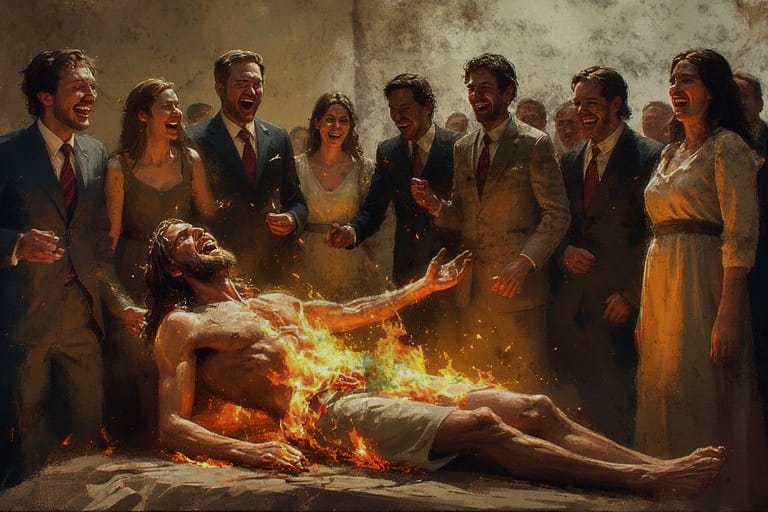
They say salvation is free, but I’ve yet to see anyone walk out of the gift shop empty-handed.
The signs all promise redemption, hand-lettered in gold leaf, illuminated by the flicker of a thousand LED halos. The air smells like incense and glue. You can almost hear the cash registers genuflect.
They call it faith. I call it vertical integration.
Every pulpit’s wired for sound now, every preacher a brand ambassador with a sermon calendar and a booking agent. They say they serve the Lord, but their social media analytics serve quarterly reports. Grace, once a whisper in the wilderness, now comes with a promo code.
You’ll find them on stages that smell of pyrotechnics and perfume, preaching austerity beneath chandeliers. Their gospel is pre-laundered, their conscience tax-deductible.
And they want you to come join them.
They’ll tell you that doubt is corrosive, that curiosity is the devil’s syntax. But if their faith were truly absolute, why the relentless need to advertise it?
Somewhere along the line, holiness became a franchise. The meek inherited the livestream. The prophets got sponsors.
There’s a peculiar irony in watching men who claim divine humility insist on front-row billing. They denounce vanity while posing for thumbnails, sermonizing about sacrifice between two paid partnerships. Their moral arithmetic is exquisite, every sin becomes a subscription, every confession, a customer-retention metric.
You may laugh. You should. Humor’s the only antiseptic left in a world that keeps infecting itself with certainty. Because the deeper you look into the light, the more you realize it’s fluorescent, manufactured, humming faintly, and liable to burn out at any moment.
So take a seat. The show’s about to start. The ushers will collect your tithes, your fears, your better angels. Keep your arms inside the pew at all times. What you’re about to witness isn’t worship.
It’s marketing disguised as miracle, and you, friend, are the demographic.
THE MACHINERY…
The faithful think it’s divine spontaneity, the sudden swell of strings, the tears cued perfectly to the bridge of a worship song. But if you stand far enough back, you’ll see the choreography. It’s all there: the light cues, the camera pivots, the emotional calculus that would make a magician blush.
Every revival has a script. Every miracle, a stage manager.
The applause feels celestial because the acoustics were designed that way; wood paneling to catch the echo, bass to stir the ribcage. Faith isn’t just preached anymore; it’s engineered.
The men upstairs don’t call it religion. They call it operations.
There’s sourcing, acquisition, brand alignment. Scripture distilled into slogans. Doubt repackaged as dissenting demographics. The devout call it revelation; the board calls it engagement.
Behind the curtain, interns catalog testimonies like data points. Every conversion is a KPI. Every hallelujah, a quarterly uptick.
The modern church doesn’t build temples, it builds funnels. The usher with the smile is a brand ambassador. The pastor’s monologue is focus-grouped within an inch of transcendence. The Holy Spirit has a mailing list and a CRM dashboard.
And somewhere in the back, a man with a headset whispers, Cue the prayer.
They call it a movement. It’s really just logistics.
You think you’re buying absolution, but what you’re really purchasing is belonging, a membership in the grandest pyramid scheme ever blessed by incense.
Faith, once ineffable, now has margins and modifiers. You can choose your tier, your merch, your denomination of outrage. Everything comes with options. Even God, it seems, is available in different subscription levels.
This is not the house of worship they promised. This is the warehouse of belief, humming at industrial volume. The machinery’s older than you think, and louder than it should be.
Welcome backstage.
Watch your step, the floor’s slick with anointing oil and marketing strategy.
THE ENTERPRISE STRUCTURE…
It isn’t chaos. It only looks that way from the pews.
Up close, it’s immaculate. Purpose-built. Faith turned into architecture.
Every creed has its hierarchy; this one simply learned to brand it.
You can smell the order: printer ink, cologne, ozone from the stage lights.
You can hear it, too; the rehearsed cadences, the communal gasp when the spotlight hits the “chosen” face onstage.
They call it a movement.
But movements don’t have payroll departments.
I. Acquisitions.
Recruitment begins with warmth, smiles calibrated to a precise wattage, slogans short enough to fit on merch.
They call it outreach. It’s really onboarding.
Here the air hums with hashtags and caffeine. Staff pray over algorithms. They don’t pass out pamphlets anymore; they pass out QR codes.
Young faces sign up for belonging, for purpose, for that addictive sense of us.
Every email added to the list is another soul harvested for “market penetration.”
The staff call it ministry; the backend calls it lead generation.
Doubt is treated like rust, scrubbed away in small groups and prayer circles.
By the third meeting, most recruits can repeat the slogans verbatim, like hymns written by a marketing firm.
They say the lost have been found.
But anyone can look found when they’re wrapped in a banner.
II. Processing.
Doubt doesn’t last here. It’s not cost-efficient.
Everything runs on predictability: belief in, tithes out.
This is the theological assembly line, a place where nuance goes to die.
The walls are plastered with Bible verses, carefully cropped to remove context.
The volunteers wear smiles like uniforms.
Every sermon is A/B tested. Every prayer has metrics.
If a testimonial underperforms, it’s edited for clarity.
If a tragedy gains traction, it’s repackaged as divine opportunity.
Somewhere, a sound engineer boosts the bass to make faith feel visceral.
The body confuses vibration for transcendence.
Here, grace comes bottled and labeled.
Here, redemption has a shelf life.
III. Brand Management.
These are the stars of the faith-industrial complex.
The faces that beam from conference banners and social feeds.
Their faith is immaculate; their lighting, impeccable.
They speak with conviction, but never improvisation.
They’ve learned to pace revelation to ad breaks.
Every public repentance doubles as a marketing pivot.
Every controversy, an opportunity for engagement.
They preach “authenticity” in photo-ready humility, all soft smiles and perfectly tousled guilt.
They remind the flock to be humble while signing six-figure speaking contracts.
They weep on cue, but never off-camera.
The televangelist, the influencer, the elected “defender of faith”, each one a saintly brand ambassador keeping the gospel on-brand and on-trend.
The miracles are televised now.
The apocalypse is syndicated.
IV. The Executives.
The sound changes here; quieter, heavier.
The prayers are shorter, the wine older, the suits darker.
This is where theology is rewritten into policy memos and campaign strategy.
Where the cross meets the balance sheet.
The board speaks in the tongues of lawyers and accountants.
They see faith not as covenant but capital.
They call it stewardship, a word that sounds holy enough to sanctify greed.
They funnel tithes into PACs, launder outrage into votes.
They talk about “protecting the unborn” in the same breath as cutting social programs.
Their sanctuaries are conference rooms.
Their hymns, quarterly reports.
If you listen closely, you can hear the soft click of pens signing contracts that have nothing to do with salvation and everything to do with control.
They don’t confess. They allocate.
V. The Franchise.
At the top of the pyramid, the light burns artificial and unblinking.
Here sits the Brand; part messiah, part mascot.
He doesn’t need to be righteous; he only needs to be marketable.
His face sells everything below him, from T-shirts to talking points.
He speaks in grievance and prophecy, equal parts victim and savior.
The crowds call him chosen. The shareholders call him essential.
He’s a mirror held up to the nation’s id. Every fear, every hunger, every secret indulgence in dominance reflected back with divine justification.
He promises deliverance but sells division, a product so addictive that even his enemies can’t stop watching.
He’s the alpha and the algorithm.
Around him, the faithful shout, the press flashes, and the machinery hums on.
The empire of belief is open for business.
Money flows up. Obedience flows down.
Outrage fuels the turbines.
It’s the perfect design; self-cleaning, self-justifying.
A perpetual motion machine powered by guilt, grievance, and grace on demand.
They call it revival.
But the books call it profit.
You are not for sale…
#ProjectBlackbird